Sep 9 2010

Devil’s Claw

Melissa Crytzer Fry

Tell me … at first glance, what do you think this is?

When we first purchased our property in rural southern Arizona in 2004 (me and hubby), we found these odd-looking twiggy-looking “hooks” all over our property. A friend once glued them to a board and drew a face around them. They suddenly transformed into the pincers of a prehistoric insect.

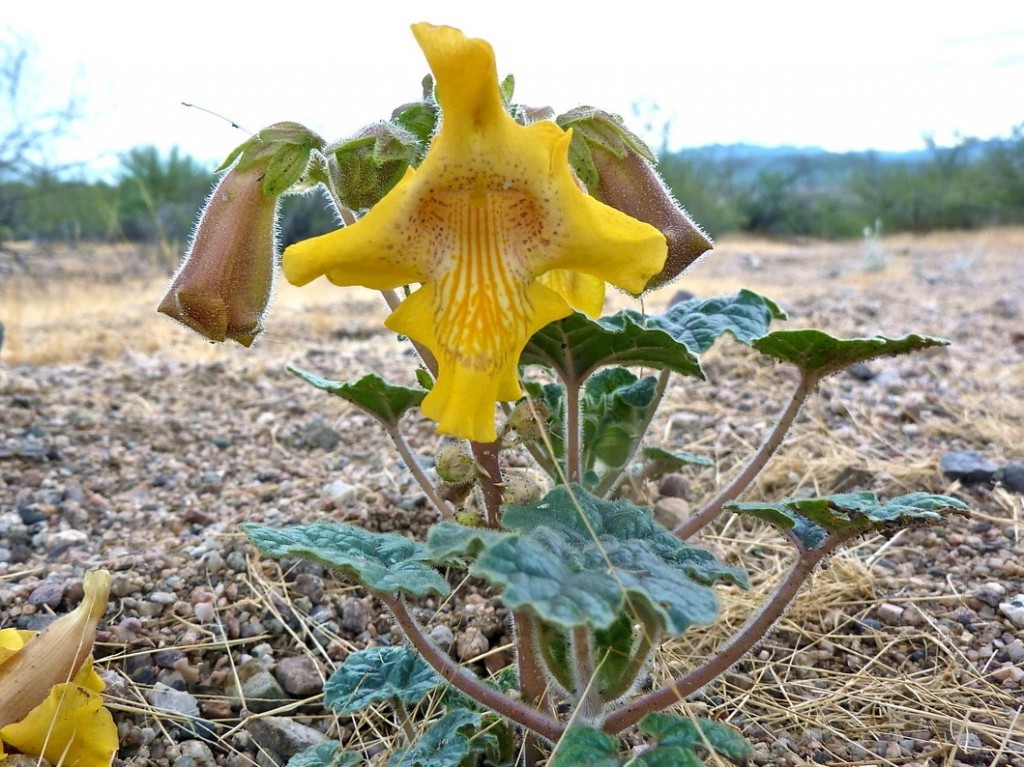
This hook-like claw is revealed after the pretty flowering plant (seen below) blooms. Click to enlarge.

Indeed, these ‘claws’ have a primordial feel to them. In actuality, they come from the lovely plant at the bottom of this post (photo by Kathy Becraft). They are called Devil’s Claw… So our first instinct to deem these foreign objects as “sinister” was shared by someone else, at least – some botanist who had the same creepy feeling when naming them.
For Writers: What’s in a name, anyway? The name “Devil’s Claw” conjures all kinds of feelings – foreboding, pain, evil. When you’re naming your characters, or even the towns they live in, the streets they roam, the names of their pets … are you thinking about the impact those names will have? Do they fit the personality type, the setting, the book’s theme?

When reading an excellent novel recently by Teri Coyne (The Last Bridge), I realized how fitting the main character’s name was to her personality, her past. “Cat” Rucker. Doesn’t that sound like a tough-as-nails name? You learn that Cat is a nickname winnowed down from the full name “Alexandra” to “Ally” to “Alley Cat,” and finally to “Cat.” Without spoiling anything, I will just say that it’s a perfect name for this character. (And the plot, characters, storyline … riveting!)

When selecting your character’s names, give them some serious consideration. Even the way the name rolls off the tongue has some appeal to readers. And in some instances, names may have hidden historic or spiritual significance. Never underestimate the power of a name!


Sep 7 2010

The Vulture’s Necessity

Melissa Crytzer Fry

They are U-G-L-Y. I’m talking turkey vultures (And, no, I was not chanting U-G-L-Y as if it were a cheer.) So back to the vulture … Have you ever seen one up close?

The bright red appendage-looking fleshy protrusions along their beaks? Their beady black eyes? The way they circle above a rotting carcass, congregating in the air before they swoop down and tear it to shreds?

Despite their unattractive appearance, I found great beauty in this photo that captured roosting vultures in the early morning light near Apache Lake in Roosevelt, Arizona. The hundreds of reflective saguaro cacti standing at attention in the background were an added bonus. Click to enlarge.

For all their ugliness, turkey vultures do provide a beautiful service in the circle of life. They clean up the dead stuff no one wants to touch. Trust me. We’ve had many experiences of smelling foul, dead things on our property. And the vultures do a fine job of ‘disposing’ of them.

Take the rattlesnake that our neighbor accidentally ran over. It slithered off to die somewhere, but we couldn’t find it among the prickly pear, despite our best efforts. We could smell it. Two days later, the smell was gone. So was the snake (save some vertebrae and his rattle lying in the middle of the driveway, which I still have). This was all, of course, thanks to the vultures.

Then there was the poor javelina that was struck by a vehicle on the highway and landed RIGHT in front of our driveway gate. After a few hours in the sun, the stench was unbearable. So when the vultures (and I don’t know how they did this, because the javelina must have weighed 20 lbs) carried him over the edge of the embankment the next day, we were happy. Oh so happy. Did I mention how sad I was at the poor guy’s fate, though? I was…

For Writers: Just as turkey vultures have a place in the ecosystem, so do our villains have a place in the novel. They may be ugly – completely unattractive – but they help characterize your protagonist. Readers get to see how your protag reacts to the bad guy. And, let’s face it: the bad guy adds that tension and conflict that is paramount to a good read. So, writers, embrace your villains. They, too, have a role. A very important one.