One Lizard & a Fencepost
Since a lot of U.S. blogs this week are going to focus on giving thanks, I’m going to live on the wild side and talk about fence posts and lizards, instead. (Don’t get me wrong … I am thankful!)
But nothing quite says desert southwest like a spiny lizard stuck to the post of a horse corral, does it?
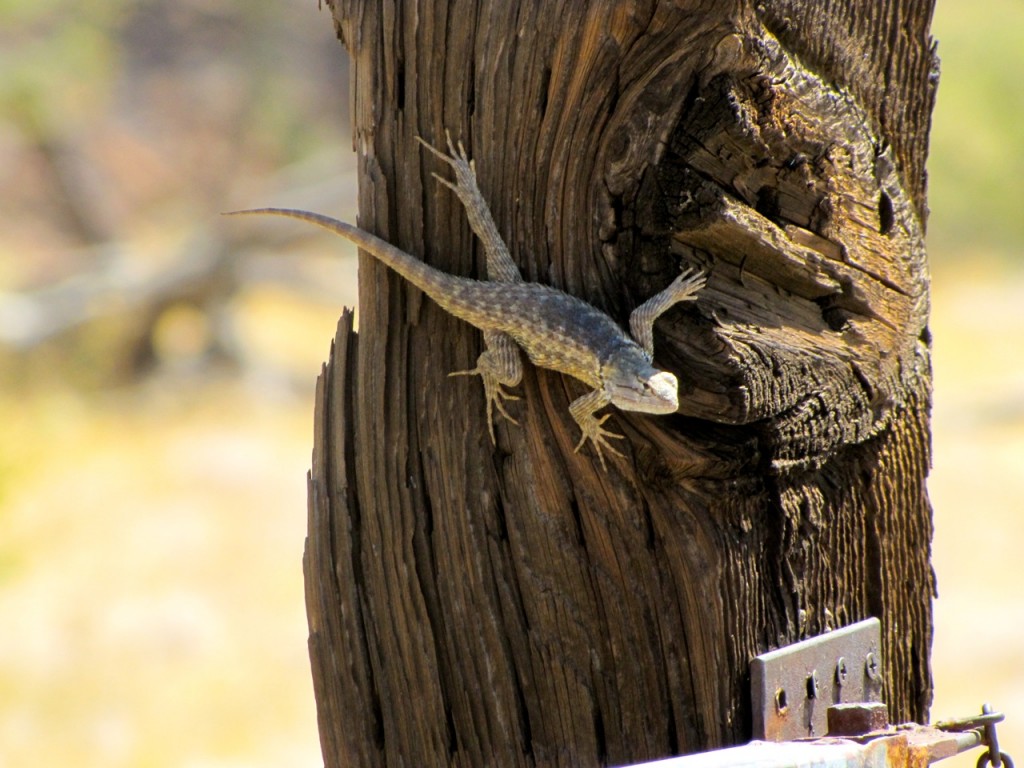
I had a friend who was so terrified of lizards that, if she saw one in her house, she’d suck it up in her vacuum. As you can imagine, my lizard-loving persona found this appalling – and perhaps even more so now that I’ve learned more about these valuable reptilian creatures.
I personally enjoy the spiny lizard’s antics; I watch one outside my window every day as he does ‘push ups’ on the railroad tie. When his tummy is full of insects, he lumbers around like a miniature crocodile. And sometimes, he even gets frisky with the ladies (I turn my head and give him his privacy).
When I watch him sunning himself, I consider all the obstacles he faces daily in the brutal desert but see that, despite such adversity, he seems to know how to have a good time. Yes, the lizard has taught me a great deal (and did I mention that lizards are also sentinels, signaling environmental disturbances when their populations decline? They often provide valuable warnings for humans.) Hooray, lizard!
For Writers: I’ve been knee-deep in the writing of my second novel. And from the start, I knew that I wanted setting to play a pivotal role; I essentially wanted it to become one of the characters in my novel.
Obviously the photo above screamed to me, “setting,” especially since my current WIP occurs in the desert southwest.
I realize setting can run the gamut – from the inside of a car and the back porch of grandma’s house to a new galaxy or the rolling hills of Montana. But for the purposes of this article, I’m referring to natural, physical-geographical settings.
So, how do you even start to make this type of setting an actual character in your novel? And how do you avoid overdoing it or making it feel too contrived?
Below are some things I’ve learned along the way:
- Keep a journal of what you see around you. (I’ve realized that my blog is actually my ‘setting’ journal. I’ve been able to use insights from posts I’ve already written. Note: If it’s not written down, you will forget the details.)
- Get to know your setting if you don’t already live in it. Research it! Talk to people who live there, visit the locale if you can, or study photos online. Study the local customs, flora, fauna, weather patterns, crop seasons, festivals. Your readers will know if you haven’t done your homework.
- Personify your setting. There is nothing I love more than a setting that has its own thoughts and human characteristics. The trees can breathe, the hills can see, the sun aches for the close of day, a wind gust can be hostile … Or in an urban setting, a building can sigh, a car can scream. You get the picture.
- Use seasons as part of setting. A good thunderstorm, blizzard or gale force wind during a painful or harrowing scene can add wondrous amounts of tension. Use the seasons and weather patterns of your setting to your full advantage.
- Determine how your characters will interact with setting. When setting is a character, it must interact/affect/touch characters in profound ways. For each scene, decide if character interaction with the setting/nature will move the plot forward, place characters in precarious situations, or remove obstacles.
- Sprinkle, sprinkle. Some longer passages of setting may be warranted, but also try to sprinkle smaller passages throughout so you don’t bog down the reader. Even though you’re trying to achieve setting as character, each chapter doesn’t have to scream ‘setting;’ rather, the book as a whole has to convey this strong sense of place.
- Look to the classics for “setting as character.” There’s no reason to recreate the wheel. Many writers – legendary and recently published – have mastered the art of setting as character, sprinkling rich details throughout their novels. Some classics and recent examples of works in which setting is character include:
- Herman Melville’s Moby Dick
- Charles Dickens’ Oliver Twist
- Joseph Conrad’s The Secret Agent: A Simple Tale
- Emily Brontë’s Wuthering Heights
- Beth Gutcheon’s More than You Know
- Sue Monk Kidd’s The Mermaid’s Chair
- CE Morgan’s All the Living
Do you appreciate books in which setting plays a pivotal role? Have you ever used setting as a character? What tips/tricks did you find helpful? What other books – recent or past – can you recall that used this technique?


