Jan 22 2012

Many-Legged Awe

Melissa Crytzer Fry

One book, among the many on my now-straining bookshelf, has earned a prime spot on the top tier, where it is easily accessible: my National Audubon Field Guide to the Southwestern States.

Before we officially moved from downtown Phoenix to our rural acreage in southeastern Arizona, I began rattling off the names of insects I had never before seen, as I saw them for the first time. (Thank you Audubon for the education – and for foreshadowing the many extraordinary insects I would eventually stumble upon … ones that simply do not exist in my native Pennsylvania.)

I thank my cats, Macho and Niña for this discovery. Their intense fascination with this beautifully painted mesquite bug outside our French doors prompted me to investigate. One of my all-time favorites (size of a silver dollar)! Click to enlarge.

Walking sticks are common on our property, as seen on this palo verde tree. I think they were absent from my childhood home due to pesticides sprayed on local crops? The western short-horned walking stick produces young without mating. Click to enlarge.

Meet the tail-less whip scorpion. I accidentally spotted this nocturnal guy with its antenna-like front legs, scuttling about under the cloak of darkness offered by our carport. This insect of the arachnid class can move quickly in any direction. Click to enlarge.

A black grasshopper? What? I was over-the-moon happy when hubby and I spotted these red-winged, grass-eating grasshoppers during a trip near Ft. Huachuca in southern Arizona. Actually, we heard them first. The “notice-me” grasshopper produces a loud rattling sound known as crepitation as it flies. Click to enlarge.
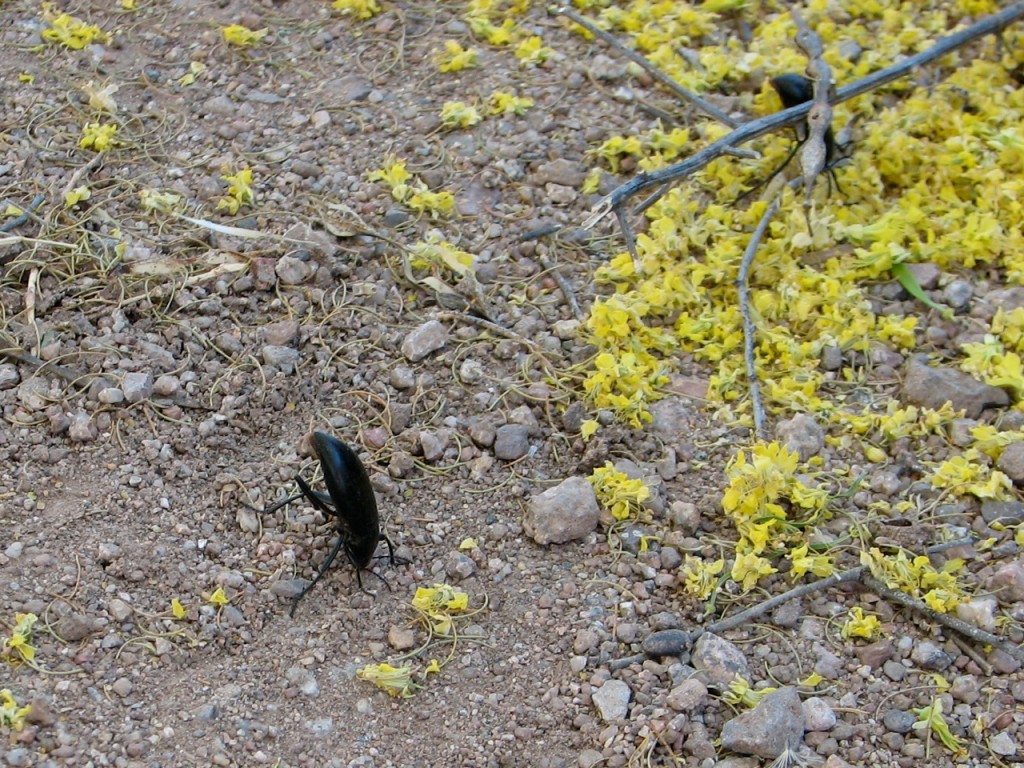
The armored stink beetle is a bit acrobatic. I first discovered these black tanks beneath lumber for our new home build. Then poor Niña encountered one in the kitchen. Yes, it raised its butt in the air and puffed its defensive, foul-smelling black liquid in her face. Poor baby sneezed quite a bit. Click to enlarge.

For me to convey how big the giant desert centipede really is, I have to explain that when it shot from beneath the outdoor garbage bin, my husband yelled, “snake!” When threatened, this invertebrate raises its rear legs, which resemble antennae, to confuse predators. Yes, this guy is mildly poisonous and bites. And two have made it into our home. Click to enlarge.

For Readers, For Writers: As writers, isn’t it our job to show the reader something new? As a reader, don’t you want to learn something new, discover something unfamiliar? You want to be exposed to a new world you’ve never before seen, interact with uniquely painted characters, and immerse yourself in sometimes supernatural, other-worldly situations.

Does your novel – or the book you’re reading – have its share of characters that exhibit traits like the nocturnal and quick moving tail-less whip scorpion, the sap-sucking but brightly colored mesquite bug, or the show-boating, frequent flyer red-winged grasshopper that engages in spectacular flight displays to attract a mate? What about those camouflaged walking sticks and cunning, head-standing armored stink beetles?

…Or kissing bugs, cactus long-horned beetles, ground mantises, milkweed bugs or broad-winged katydids? Maybe that’s another post (and, yes, I have photographed them all). I’m sure some of you are squeamish already.


Jan 8 2012

Of Dogs & Prairie Dogs

Melissa Crytzer Fry

I expected to see dogs this past weekend. Lots of them. Brittany Spaniels, to be exact, and one little gal in particular: Pearl.

Six-month-old Brittany Spaniel, Pearl, is the baby of our neighbors, Mark and Roxanne. She awaits her first puppy field trial. Click to enlarge.

I did, in fact, see a lot Brittanys — excited by the horses and riders, the camping trailers, by one another’s eager barking, by the tinny blanks fired from guns to signify a bird ‘find.’ (No birds were killed. The dogs simply needed to stay on point once they located a bird).

Dog owners could walk their dogs along the trail, or they could ride horses. We walked behind as Pearl’s doggy dad, Cody, competed. You can see a Brittany low in the grassland to the right. We missed Pearl’s competition the next morning (boo). We hear she did pretty well against "Bucky." Click to enlarge.

This horse took my breath away, and this photo is going on my wall! Click to enlarge.

What I didn’t expect to see during this weekend adventure: prairie dogs. Rewind back a few years, and I wouldn’t have seen them. No one would have. Unfortunately, black-tailed prairie dogs vanished from Arizona’s landscape nearly 50 years ago, the result of human-related poisoning and habitat fragmentation.

Click to enlarge to see this plump prairie dog along the mound to the right.

In 2008 this community of black-tailed prairie dogs was reintroduced to the Las Cienegas National Conservation Area in Sonoita, Arizona. When the population is stable, these “little dogs” will be ushered to four additional sites in southern Arizona, beyond the area pictured above. Such actions are aimed at preventing the species’ inclusion on the Endangered Species list.

While many may view these furry little critters as nothing more than pests, they actually play a key ecological role.

“Black-tailed prairie dogs maintain grasslands for other animals to forage and serve as important prey for eagles and hawks,” says Eric Gardner of Arizona Game and Fish. “Because of the far-reaching effect they have on other species, successful re-establishment would benefit the whole ecosystem by maintaining species diversity.”

Did I mention that I witnessed some of that species diversity? I watched a pair of Harris’s hawks catching the updraft and steering into strong head winds, levitating over the vast prairie grasses before me. I saw sparrows, doves and ravens, too. Did I also mention that I was as smitten with the landscape as I was by the prairie dogs and lovely little Pearl?

It was easy to get lost in the deepness of these golden grasslands, the mountains near the Mexico border rising behind them. Click to enlarge. (This photo is going on my wall, too).

Yucca, mesquite and prairie grass add to the area’s diversity. Click to enlarge.

The drive home among this desert grassland was reminiscent of a trip we’d taken to Sonoita and Sahuarita – Arizona’s wine country – back in the summer of 2010.

In spite of the beautiful vistas and the dusty back roads we traveled then, we were reminded of the harshness of this part of the state. Not just its oppressive heat and arid soil.

Another sign we encountered (not pictured) indicated "licensed vehicles only" with a warning to expect up to six years imprisonment and up to $6,000 in fines if unlicensed. Not knowing what 'license' was required (U.S.?), we took a different route.

These signs are common, as are the Border Patrol stops (I would have taken a picture of a Border Patrol station for you, but I didn’t think the officers would take kindly to me pointing a camera at them as they held firearms at their sides).

The signs reminded me, in an instant, that so much more lives on these grassy plains than what meets the eye: danger, passion, dreams, survival. And – once again – the black-tailed prairie dog.

For Readers & Writers: This weekend adventure revealed to me the importance of juxtaposition in fiction. When I looked around, I saw both beauty and danger, struggle and promise. Novels that introduce readers to seemingly disparate emotions, settings and concepts often seem the most satisfying, don’t you think? Does your novel – or the book you’re reading – have the right mix of both, the right amount of resulting tension? How do you achieve that kind of balance in your writing?